


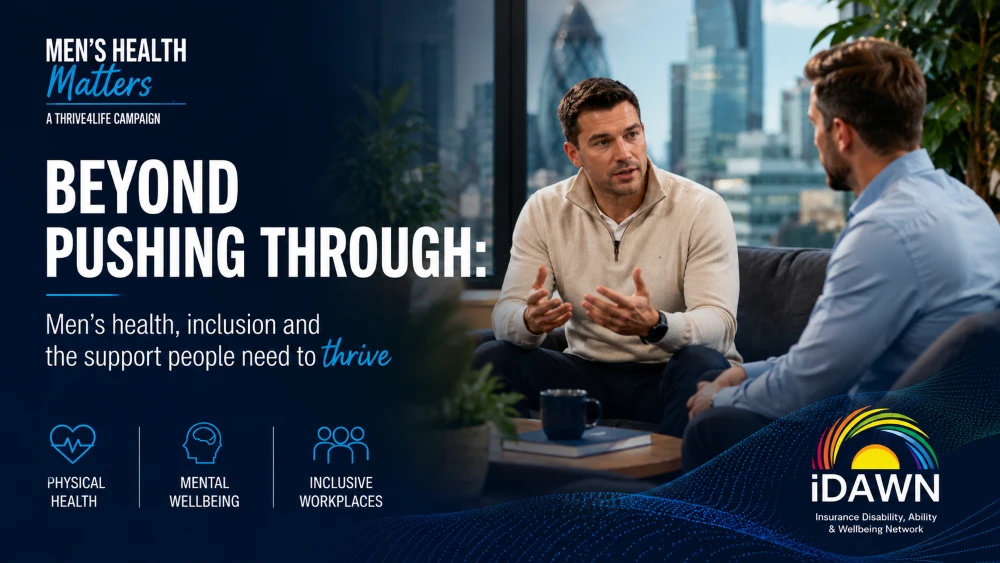
Beyond Pushing Through: Men’s Health, Inclusion and the Support People Need to Thrive
Why iDAWN is supporting Men’s Health Matters
There is a phrase that often sits quietly underneath conversations about men’s health: “just push through”.
Push through the pressure, the tiredness, the stress, the symptoms, the difficult period at work, the family worries, the low mood, the pain or the anxiety.
For many men, pushing through can look like strength. But sometimes, it is simply another way of staying silent.
That is why Thrive4Life’s Men’s Health Matters campaign is so important. It is not just about clinical health. It is about culture, inclusion, prevention and the environments we create around people. It asks what needs to change so that men feel able to speak up, seek support and take action before problems become crises.
For iDAWN, the Insurance Disability, Ability and Wellbeing Network, this is a natural conversation to support.
As a volunteer-led network promoting inclusion across the insurance industry, iDAWN focuses on disability, ability, wellbeing, mental health and open discussion. Its mission is rooted in a simple idea: people should be able to work in environments where they are understood, supported and included - especially when their challenges are hidden.
Men’s health belongs firmly in that conversation.
Not every struggle is visible
So much of health and wellbeing sits beneath the surface.
Stress, anxiety, depression, chronic pain, fatigue, grief, neurodivergence, long-term health conditions and emotional strain are not always obvious. In a busy workplace, it is easy to assume someone is fine because they are still turning up, delivering, answering emails and appearing to cope.
But appearing to cope is not the same as being well.
This is especially true in high-performing sectors such as insurance, where people are used to being capable, responsive and relied upon. Someone who is struggling may not look like they are struggling. They may simply become quieter, more withdrawn, more tired, less engaged -or more determined to keep going at all costs.
For many men, this can be even harder. Strength is often associated with self-reliance, composure and not making a fuss.
That is why inclusion matters. Inclusive workplaces do not wait for someone to reach breaking point. They create the conditions where people feel safe enough to say, “I’m not okay,” “I need help,” or “something needs to change.”
Appearing to cope is not the same as being well.
The lesson from Ben Youngs: strength is asking for help when you need it
This message came through powerfully in Thrive4Life’s flagship Men’s Health Matters interview with Ben Youngs.
As England’s most capped men’s rugby player, Ben Youngs understands pressure, resilience and the expectation to keep going. But what made the interview with him so compelling was not just his sporting success, it was his honesty.
Ben spoke about a period when family grief, pressure and rugby became impossible to separate. He described realising he needed professional help and going to see the sports psychologist available to him. Looking back, he reflected that he perhaps should have done it earlier.
That is a moment many people can relate to.
Too often, we do not seek help at the first warning sign. We wait, rationalise and tell ourselves we are too busy, that it will pass, or that now is not the right time.
Ben’s story reminds us that strength is not pretending nothing is wrong. Strength can be recognising the need for support, speaking to someone and taking action before things become unmanageable.
That is exactly the message workplaces need to normalise.
Physical health matters too
Men’s Health Matters also reminds us that early action is not only about mental health.
Ben spoke about experiencing an abnormal heart rhythm during rugby training. His heart was racing, he knew something felt wrong, and he called the medics over. That decision led to assessment, treatment and recovery.
It is a powerful reminder to know your body and take symptoms seriously.
Too many men delay acting on chest pain, palpitations, fatigue, persistent discomfort, lumps, sleep disruption or simply feeling unusually unwell, often because they are busy, frightened, or do not want to make a fuss.
But prevention is practical. Booking an appointment, checking blood pressure, attending a screening, joining a webinar or asking a question can all be small steps with significant consequences.
Why inclusion and men’s health are connected
Men’s health is often treated as a medical issue. Clinical education and healthcare access matter, but health is also shaped by culture.
Do people feel safe to speak openly? Do managers know how to respond? Are adjustments understood? Are mental and physical health taken equally seriously? Are people encouraged to act early, or only noticed at crisis point?
These are inclusion questions.
For iDAWN, this is where Men’s Health Matters fits so naturally. Disability, ability and wellbeing are not separate from workplace culture. They are part of it.
An inclusive workplace recognises that people may need different support at different points in their lives, whether that is flexibility, adjustments, signposting, mental health support or simply a better conversation with a manager.
Support is not special treatment. It is often what enables people to contribute fully, sustain their careers and perform at their best.
Support is not special treatment. It is often what enables people to contribute fully, sustain their careers and perform at their best.
From awareness to action
The real value of awareness campaigns is not just that they start conversations. It is that they create routes into action and act as a catalyst to continue the conversation.
Men’s Health Matters does this by combining high-profile engagement with practical health education across areas including heart health, blood pressure, cholesterol, blood sugar, prostate and testicular cancer, and mental health under pressure. The ECG and blood pressure checks add a very practical reminder: early action can be simple, direct and potentially life-saving.
For employers, the message is clear. Men’s health should not sit on the edge of workplace wellbeing. It belongs in the mainstream conversation about inclusion, performance, culture and support.
That means making trusted information easy to access. It means repeating health messages in different ways. It means encouraging people to act early. It means ensuring managers are confident to respond with empathy and signposting. It means creating a culture where someone does not have to be in crisis before they feel entitled to ask for help.
Why iDAWN’s support matters
iDAWN’s support for Men’s Health Matters reflects its commitment to helping people across the insurance industry thrive.
This campaign is not only about men. It is about the colleagues, families, teams and communities around them. When someone struggles in silence, the impact rarely stays with one person. When someone gets the right support early, the benefits ripple outwards.
For iDAWN, the message is simple and important: people should not have to mask, minimise or push through alone.
They should be able to work in environments where hidden challenges are understood, where support is visible, where conversations are normalised, and where health is treated as part of inclusion.
Men’s Health Matters helps move that conversation forward.
It reminds us that wellbeing is not a luxury, support is not weakness, and early action should never feel like failure.
It is how people thrive.
Discover iDAWN
iDAWN, the Insurance Disability, Ability and Wellbeing Network, is a volunteer-led network promoting disability, mental health and wellbeing inclusion across the UK insurance industry. Its work helps raise awareness, encourage open conversations, strengthen support and create a culture where people can thrive.
Find Out More About Men’s Health Matters
Explore the campaign, access the free webinar series and discover how workplaces across the City are supporting earlier conversations, earlier action and more inclusive approaches to men’s physical and mental health.
Categories
